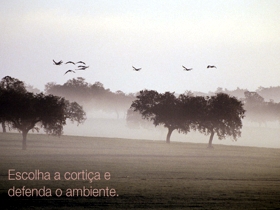
Cork and the Environment
Cork oak forests are delicately-balanced
ecosystems, very specific that persist only in the Mediterranean
region (Algeria and Morocco) and particularly in the south of
Europe as in Portugal, where is the largest cork oak tree area (around
730 thousand hectares representing 33% of the whole cork in the
world).
Considered a national heritage, cork oak forests have been
legally protected for centuries (Decree-Law 169/2001). The trees
may not be cut down and incentives are available for the
planting and management of cork oak forests. This initiative,
pioneered by Portugal, was clearly a good decision, since the
harvesting of cork has become an industry of great economic
importance and Portugal has become the main international cork
exporter.
Cork in Portugal
In Portugal, cork oak forests represent
around 21% of the total forested area and are responsible for
the production of more than 50% of the cork consumed throughout
the world. This forests have species designated by Quercus
(Quercus – National Association for Nature Conservation) - large
areas of holm oak (Quercus rotundifolia), small areas of
Pyrenean oak (Quercus pyrenaica) and, above all, cork oaks
(Quercus suber L). Of the entire flora in cork oak forests, the
cork oak is the most numerous specie and can be found throughout
the country, from Minho in the north to the Algarve in the south,
except in the harshest areas of Trás-os-Montes and the coldest
hilltops and slopes of north Portugal. However, cork oaks are
most commonly associated with the landscape of the Alentejo,
where they indeed grow on a large scale. (APCOR)

Cork History
Cork oak forests are delicately-balanced
ecosystems, very specific that persist only in the Mediterranean
region (Algeria and Morocco) and particularly in the south of
Europe as in Portugal, where is the largest cork oak tree area (around
730 thousand hectares representing 33% of the whole cork in the
world).
Considered a national heritage, cork oak forests have been
legally protected for centuries (Decree-Law 169/2001). The trees
may not be cut down and incentives are available for the
planting and management of cork oak forests. This initiative,
pioneered by Portugal, was clearly a good decision, since the
harvesting of cork has become an industry of great economic
importance and Portugal has become the main international cork
exporter.
In Portugal, cork oak forests represent around 21% of the total
forested area and are responsible for the production of more
than 50% of the cork consumed throughout the world. This forests
have species designated by Quercus (Quercus – National
Association for Nature Conservation) - large areas of holm oak
(Quercus rotundifolia), small areas of Pyrenean oak (Quercus
pyrenaica) and, above all, cork oaks (Quercus suber L). Of the
entire flora in cork oak forests, the cork oak is the most
numerous specie and can be found throughout the country, from
Minho in the north to the Algarve in the south, except in the
harshest areas of Trás-os-Montes and the coldest hilltops and
slopes of north Portugal. However, cork oaks are most commonly
associated with the landscape of the Alentejo, where they indeed
grow on a large scale. (APCOR)
 sustainability. This tree has such a regeneration capacity that even
without chemical herbicides, fertilizers or irrigation, during the
nine years between each harvest, the bark regrows, ready for the new
cork harvest.
sustainability. This tree has such a regeneration capacity that even
without chemical herbicides, fertilizers or irrigation, during the
nine years between each harvest, the bark regrows, ready for the new
cork harvest.